Transpose Transpose ▲▼  

Reference Pitch Tuning – Play Along in Any Tuning Standard

Learn how Reference Tuning in Transpose lets you match recordings tuned to 432 Hz, Baroque 415 Hz, or any non-standard pitch — and why classic recordings are often slightly sharp or flat.

Reference Pitch Tuning – Play Along in Any Tuning Standard
Features
reference-tuning pitch tuning 432hz 440hz baroque pro guitar practice vinyl tape remastering

Why A = 440 Hz is not the only tuning

Most modern music is produced at A = 440 Hz — the international standard since 1955. But not all music follows that convention. Orchestras, historical ensembles, and individual artists have used different reference pitches for centuries, and many still do today.

If you try to play along with a recording that uses a different pitch standard, every note will feel slightly “off” — even when your transposition is technically correct. That is exactly the problem Reference Tuning solves.

What is Reference Tuning in Transpose?

Reference Tuning is a Pro feature that lets you tell Transpose two things:

  1. Track tuning — the pitch standard of the recording you are listening to.
  2. Instrument tuning — the pitch standard of your own instrument or voice.

Transpose calculates the difference and applies it automatically. Your semitone and pitch controls then stay musically accurate relative to both the track and your instrument.

Practical workflow

  1. Enable Reference Tuning in Settings → Audio engine options.
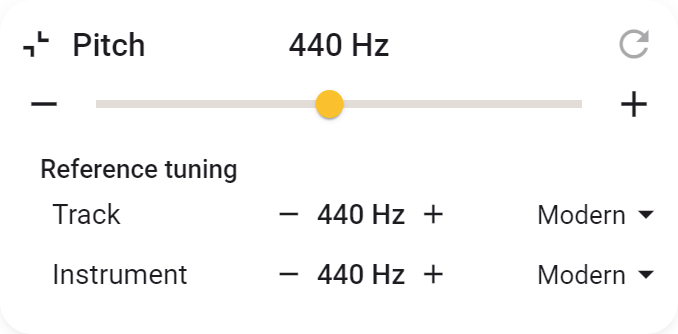
  2. In the Pitch panel, set Track to the recording’s tuning frequency.
  3. Set Instrument to your instrument’s tuning frequency.
  4. Play along — Transpose handles the math.

Reference Tuning panel — Track set to 430 Hz Classical, Instrument set to 440 Hz Modern

Built-in tuning presets

Transpose ships with quick-select presets for the most common standards:

PresetFrequencyTypical use
French Baroque392 HzEarly French repertoire
Baroque415 HzBaroque-era ensembles, harpsichord
Classical430 HzLate 18th / early 19th century orchestras
Earth frequency432 HzAlternative tuning popular in some wellness and music communities
Modern440 HzInternational concert pitch standard
442 HzMany European orchestras today
443 HzSome US and European orchestras
445 HzBrighter orchestral pitch used in parts of Europe
Chorton465 HzGerman church organ pitch, Baroque era

You can also dial in any custom frequency if your situation does not match a preset.

A brief history of pitch standards

Pitch has never been truly universal. Before international standardization, concert pitch varied wildly:

  • Baroque era (1600–1750): pitch ranged from roughly 392 Hz to 465 Hz depending on the region and instrument type. French Baroque instruments sat low (around 392 Hz), while German church organs (“Chorton”) were considerably higher at around 465 Hz.
  • Classical era (1750–1820): pitch settled closer to 430 Hz in many orchestras but still varied by city and ensemble.
  • Romantic era onward: a steady upward drift toward brighter, more projecting sound pushed orchestral A higher and higher. In 1939 an international conference proposed A = 440 Hz, formalized by ISO in 1955.

Today many top orchestras still tune above 440 — the Berlin Philharmonic, for example, commonly tunes to 443 Hz or higher.

Guitar tuning: how legends used different pitches

Jimi Hendrix — tuned down a half step

Jimi Hendrix is one of the most famous examples of a guitarist who did not play in standard tuning. He routinely tuned all six strings down by one half step (E♭ tuning: E♭–A♭–D♭–G♭–B♭–E♭).

Why? Several reasons worked in his favor:

  • Looser string tension made his aggressive bending style easier, allowing those signature wide bends.
  • Darker, heavier tone. The slightly lower pitch gave his Stratocaster a thicker, warmer character.
  • Vocal comfort. The lower key often sat better in his vocal range.

If you play along with a Hendrix track in standard E tuning, every chord will clash by a half semitone. With Reference Tuning in Transpose you can shift the track up to 440-standard or shift your playback down to match — and the rest of your pitch controls stay accurate.

Stevie Ray Vaughan — tuned down a half step (and used heavy strings)

Stevie Ray Vaughan also tuned to E♭, just like Hendrix — but his approach had a twist. He used extraordinarily heavy gauge strings (typically .013–.058) on his Stratocasters. The half-step-down tuning compensated for the brutal tension those strings would have in standard tuning, making them playable while preserving his powerful, thick tone.

The result was a sound that is unmistakably SRV: fat, singing sustain with aggressive attack. Tracks like Pride and Joy, Texas Flood, and Cold Shot are all in E♭ tuning. Try to jam along in standard tuning and you will immediately hear the mismatch.

How to play along with Hendrix or SRV using Transpose

  1. Open the track on YouTube, Spotify, or another supported site.
  2. Enable Reference Tuning in Transpose settings.
  3. Set Track tuning to match the recording — for most Hendrix and SRV tracks, the recording is already in E♭, so the effective reference is roughly a half step below 440 Hz. You can fine-tune by ear or set the track reference and transpose to taste.
  4. Set Instrument to your own tuning (440 Hz standard, or E♭ if you have tuned down to match).
  5. Transpose calculates the offset — now your semitone and pitch controls are perfectly aligned.

You can also simply use the main Transpose control to shift the track by +1 semitone to bring an E♭ recording up to standard E. Reference Tuning shines when you need precise, sub-semitone corrections or when multiple tuning factors stack up.

Why so many old recordings are not at 440 Hz

Deliberate alternate tunings like Hendrix and SRV are only half the story. A huge number of classic recordings are slightly sharp or flat for reasons that have nothing to do with artistic intent — and the drift is usually just large enough (10–30 cents) to make playing along uncomfortable, yet too small to fix with a whole-semitone transpose.

Tape machines drifted

Before digital recording, pitch was tied to the physical speed of the tape. Professional reel-to-reel decks were mechanical devices: capstan wear, mains voltage fluctuations, and temperature changes all caused tiny speed errors. A 1 % speed drift shifts pitch by roughly 17 cents. When master tapes were copied — for safety, mixing at another studio, or international release — each generation added its own offset. By the time a third-generation copy reached a pressing plant, cumulative drift of 15–25 cents was common.

Deliberate varispeed in the studio

Producers routinely sped up or slowed down the tape as a creative tool. George Martin sped up vocals and instruments on Beatles recordings; the piano solo in In My Life was recorded at half speed. Berry Gordy at Motown was known for speeding up final mixes by a small percentage to add energy — many Motown classics sit a few cents, sometimes nearly a quarter tone, above the performed pitch. Cutting engineers sometimes sped up mixes to squeeze an extra track onto a vinyl side without sacrificing bass response.

Radio stations sped things up further

In the era of terrestrial radio, stations competed for airtime. A common trick was to play records 1–3 % faster to fit more songs and ads into each hour. The speed-up raised pitch by 17–50 cents — small enough that casual listeners rarely noticed, but enough to make the album version feel oddly “slow” if you grew up hearing the radio edit.

The remastering lottery

When a classic album is remastered for CD or streaming, the engineer decides whether to correct for accumulated speed errors. Different engineers make different calls, so the same album can exist at multiple pitches across releases. The Beatles catalog is a well-known example: across original pressings, 1987 CD masters, 2009 remasters, and 2015 remasters, individual tracks differ by up to a quarter tone.

Pre-standardization recordings

Before A = 440 Hz was formalized in 1955, studios, orchestras, and club pianos each chose their own pitch. 1940s US and UK recordings typically land between 438 and 442 Hz; European orchestras sat higher at 442–445 Hz; jazz recordings from the 1930s vary widely, sometimes within the same session.

Digital-era transfers

When analog tapes are digitized, the pitch is locked to the converter’s sample rate and the tape playback speed. A mismatch bakes the error into the digital file permanently — some early CD releases from the 1980s suffer from exactly this, and the error lives on in streaming catalogs.

Quick reference: why is this recording not at 440?

Likely causeTypical driftEra
Tape machine speed error5–25 cents1950s–1990s
Deliberate varispeed (creative)10–100+ cents1960s–1980s
Vinyl cutting speed adjustment5–15 cents1950s–1990s
Radio station speed-up17–50 cents1960s–1980s
Pre-440 Hz standard tuning10–40 centsPre-1955
Remastering speed choices5–20 cents1980s–present
Digital sample rate mismatch5–30 cents1980s–2000s

Tip: if a recording is only a few cents off, you can also use the fine pitch slider (± 100 cents) to nudge the playback into tune by ear, without the full Reference Tuning setup. For persistent or stacked offsets, Reference Tuning is the more precise solution.

Other scenarios where Reference Tuning helps

  • Baroque practice: your modern instrument is at 440 Hz but the ensemble recording is at 415 Hz — a full semitone difference that compounds when you add transposition.
  • 432 Hz recordings: a growing library of re-tuned music and original recordings uses A = 432 Hz. Reference Tuning lets you match without guessing the cents offset.
  • Orchestral auditions: the orchestra tunes to 442 or 443 Hz. Practice with the recording adjusted to your instrument’s actual pitch.
  • World music and ethnic instruments: many traditional instruments have fixed pitch values that do not align neatly with 440 Hz.
  • Classic recordings with tape drift: the track you want to practice is 15 cents sharp because of decades-old tape speed errors or a remaster that landed at a different pitch than the original vinyl.

Reference Tuning + Varispeed

When Varispeed is enabled, Reference Tuning adjustments also drive linked speed/pitch behavior. This means you get the same artifact-free, natural playback quality while staying in tune with a non-standard recording — the best of both worlds for small corrections.

Try it

Reference Tuning is available in Pro Trial (free for 7 days) and Pro Active. Install Transpose, start a trial, and dial in the tuning of any recording you practice with.